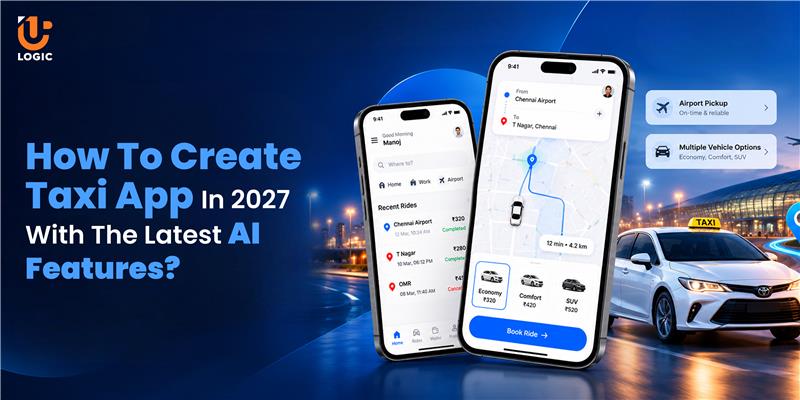
The taxi industry is now moving beyond basic ride booking. In the upcoming year 2027, customer expectations are for faster pickups, reliable fare estimates, live tracking, and quick support. Moreover, with the innovations in AI, taxi operators and business owners manage their bookings efficiently and adapt to the changing demand.
In the AI era, taxi app development in 2027 requires businesses to define their operating model and integrate AI features to solve real transportation problems. Intelligent dispatch, demand forecasting, route optimization, and fraud detection can help businesses to improve service quality and manage operations smartly.
If you are a business owner looking to launch an AI-powered taxi app, then this blog is for you.
The blog explains how to create taxi app with modern AI capabilities, from business planning to deployment.
Steps to Create a Taxi App with AI-Enabled Features
The following steps will answer your question about how to create taxi app. Proper planning and the right tech stacks enable you to launch and make your taxi app effective. The following steps help you to build a taxi app with AI-enabled features.
1. Define Your Taxi Business Model
Before starting taxi app development, decide how your business will serve customers and generate revenue. Get a clear idea of this, as the business model determines the features, integrations, and infrastructure you need.
Common models include:
- Local taxi booking to connect customers with licensed drivers within a specific city.
- Ride-hailing to connect customers and drivers via an on-demand platform.
- Corporate transportation to manage employee travel, business travel, and scheduled pickups.
- Airport transfers to support booking, flight-related scheduling, and fixed-fare journeys.
- Electric vehicle taxis to manage EV bookings, vehicle availability, and charging requirements.
2. Identify the Essential Taxi App Features
A commercial taxi booking platform typically includes three components such as a passenger app, a driver app, and an admin dashboard.
Passenger app: Customers register, enter pickup and drop-off locations, compare vehicle categories, estimate fares, book rides, track drivers, make payments, and submit reviews. Emergency assistance and trip sharing options strengthen passenger safety.
Driver app: Drivers get ride requests, trip acceptance control, navigation, availability settings, and access to trip history. Clear performance summaries help drivers to understand their work.
Admin dashboard: Business owners get full control to manage drivers, customers, bookings, commissions, payments, complaints, promotions, and reports. Operational analytics help them to monitor performance and make decisions.
3. Integrate the Latest AI Features for Taxi Apps
By analysing taxi booking data, geographical information, traffic patterns, and operational trends, AI can assist in making quicker decisions that will benefit taxi businesses. The most effective features in 2027 will be the ones that enhance business outcomes.
AI-powered ride dispatch
Traditional dispatch systems prioritize the nearest driver available. AI-powered dispatch can analyze the pick-up time, traffic, type of vehicle, driver availability, and acceptance habits to suggest a match. This can help avoid inefficient assignments for an operator and maximize utilization of their fleet. The system should also have a sense of equality and not always provide opportunities for only a few drivers.
Predictive demand forecasting
Machine learning can review past bookings, weather, holidays, and local events to predict where there might be a surge in ride requests. Taxi operators can use these predictions to schedule their taxi drivers ahead of peak hours. Improved demand planning can help to minimize idle time and lost bookings.
Intelligent route optimization
AI examines the traffic conditions, road closures, and previously recorded travel patterns to suggest efficient routes. Clean estimates aid passengers in planning travel and make it easier for drivers to avoid making unnecessary detours. Actual results are subject to data quality, mapping coverage, and local road conditions.
Dynamic fare recommendations
AI can also help businesses to estimate fares based on the distance, time expected to take, demand, and the availability of drivers. The operators can set the pricing rules and use AI to suggest pricing changes that fall within the rules. Transparent pricing is important. Price structures should be validated to ensure they are accurate, fair, and meet local laws.
AI fraud detection and customer support
Machine learning can identify strange booking behaviours, when the same promotions are used repeatedly, unusual payment activity, or if an account is potentially being misused. These alerts should support investigation rather than automatically treating every unusual transaction as fraud. AI chatbots can also provide answers to frequent queries related to bookings, cancellations, payments, and trip status. Human intervention must be in place in case of emergencies, disputes, and complicated cases.
4. Follow a Structured Taxi App Development Process
A strategic development process helps businesses to control scope, budget, and launch risks.
Step 1: Conduct market research. Research other competitors, customer expectations, local taxi laws, taxi driver availability, and possible income areas. Determine a particular issue for which your service can help.
Step 2: Make a plan for the product. Prepare the requirements of the passenger and driver workflows, admin dashboard, payment system, notifications, and AI integration. Focus on critical functions for the first release.
Step 3: Design the interface. Design wireframes and prototypes for booking, ride acceptance, tracking, payments, and trip management. Test these workflows prior to development with potential users.
Step 4: Develop the platform. Develop mobile apps, backend services, database, and administration tools. Make mapping, payment, communication, and AI services an integral part where necessary.
Step 5: Test and launch. Ensure booking accuracy, GPS performance, payment security, dispatch logic, and application performance during peak load. Do a small launch before moving to other service areas.
Step 6: Enhance post-launch. Track rides, cancellations, pick-up times, customer complaints, and driver activity. Use these insights to prioritize updates and refine AI models.
5. Choose the Right Technology Stack
The tech stack should be compatible with real-time booking systems and location tracking, as well as secure transactions and future expansion.
- Mobile development: Flutter or React Native for cross-platform applications, or native for Android and iOS when necessary.
- Database Development: Utilizing a suitable database solution, such as MySQL, PostgreSQL, or a related platform, depending on the product structure.
- Maps and navigation: Google Maps Platform, Mapbox, or equivalent navigation tools that are available in your target market.
- AI and machine learning: Prediction, classification, and recommendation systems using Python-based frameworks and managed AI services.
- Cloud infrastructure: AWS, Microsoft Azure, or Google Cloud for hosting, storage, monitoring, and scalable computing.
- Payments and Notifications: Payment providers and Messaging services for your target region.
6. Understand the Cost of Taxi App Development
The development of a taxi app in 2027 involves several factors, such as features, platform coverage, integrations, development location, and AI requirements.
A basic application including booking, GPS tracking, payments, and driver management may cost less when compared to an enterprise platform, which includes predictive analytics, advanced dispatch, fraud detection, and custom AI models.
Budget for these areas:
- Product planning and UI/UX design
- Passenger and driver app development
- Backend systems and admin dashboard
- Maps, payments, and third-party integrations
- AI implementation, testing, and data preparation
- Cloud hosting, maintenance, and security updates
There are also recurring costs associated with AI, such as API usage fees, monitoring model performance, and storing data and retraining models as needed. Ask for separate estimates covering the initial launch, optional AI features, and ongoing operational costs.
7. Prioritize Security, Scalability, and Responsible AI
Payment-related records, personal information, and sensitive location data are managed by a taxi platform. Therefore, security has to be integrated from the start of development. Adopt encryption, access controls, user authentication, data retention, and vulnerability assessment. Look at privacy, transportation, and payment requirements that are applicable in all target markets. AI systems must be continually evaluated. Track prediction accuracy, explore unfair results, and human review for impactful decisions. Design the architecture so that additional cities, languages, vehicle categories, and services can be introduced without rebuilding the entire platform.
Build Your Taxi App for 2027
By now, your query on how to create taxi app is addressed, and you will get a clear idea of it.
Developing a taxi app is something more than including the familiar booking features. Businesses need a clear operating model, secure infrastructure, reliable applications, and AI capabilities to address the challenges in dispatch, demand planning, pricing, and customer support.
Looking for a taxi app development partner? Work with Uplogic; our team translates your business requirements into a scalable mobility platform, integrates relevant AI capabilities, and supports the product beyond launch. Our well-planned development strategy can help your taxi business adapt to changing customer expectations and build a foundation for long-term growth.
FAQs
Essential AI features include intelligent driver-passenger matching, predictive demand forecasting, AI-powered route optimization, dynamic pricing, fraud detection, and chatbot-based customer support.
AI improves taxi app efficiency by matching passengers with nearby drivers, predicting ride demand, optimizing routes, and adjusting fares based on real-time conditions. AI-powered chatbots can also handle common customer queries, while fraud detection systems help identify suspicious bookings and payment activity.
Developing an AI-powered taxi app typically requires a mobile framework such as Flutter or React Native, a backend built with Node.js, Python, or Java, and a database such as PostgreSQL or MongoDB. Google Maps or Mapbox can support mapping and navigation, while machine learning frameworks such as TensorFlow or PyTorch can power AI features.