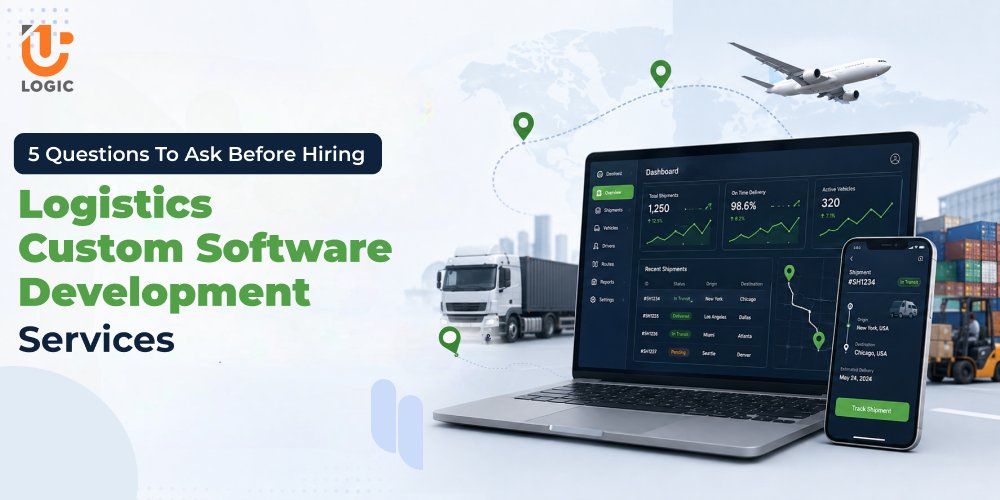
Logistics companies require a system to manage shipments, organize workflows, and enhance reporting. But what if the software lags in giving them operational control or struggles with visibility? That can drastically impact your profit margins and impede your ability to grow. Initial conversations with the software development partner carry significance in upgrading the tool for your progress. That’s how you can better evaluate logistics custom software development services so as to build systems that fit your unique supply chain needs and scale efficiently.
The digital infrastructure should serve as a shield, protecting you from operational chaos, manual workarounds, system friction, and stagnant technology. We’ll explore the advantages of custom systems and the key questions to ask before making an informed decision when choosing a logistics software development company.
The Changing Face of Logistics Software Development
Port congestion, inventory imbalances, and transportation delays drove logistics companies to invest in modern tools. And then, maintaining individual tools for transportation management, digital freight matching, and warehouse management led to data silos, high integration and maintenance costs, and workflow inefficiencies. Modern logistics software combines the benefits of these tools and empowers companies with the robust digital infrastructure that elevates agility, operational control, visibility, and system integration.
The new era reflects the evolution of software from basic tracking tools into unified, AI-driven cloud platforms that optimize and transform supply chain operations. Gartner reports that 87% of supply chain professionals plan to invest in resilience over the next two years, adapting their technologies and strategies to respond effectively to structural changes. Thus, these trends reflect a shift toward adopting newer technologies in place of outdated legacy systems.
- Companies are moving towards connected systems that ensure a smooth flow of information.
- AI engines forecast customer demand and show optimal delivery paths based on live traffic and historical trends.
- Precision in inventory sorting and management is enhanced through the use of computer vision and robotic control systems.
- IoT and telematics integration into modern software helps monitor exact locations and asset conditions.
How Emerging Software Development Companies Are Innovating Logistics Software
Leading software development companies trace their own paths to transform logistics operations with their custom apps. Businesses observe logistics apps as innovative platforms that help visualize results faster than improving every aspect manually.
Blockchain-Enabled Operational Transparency
Blockchain technology offers significant benefits in terms of stakeholder trust, increased accountability, and improved shipment traceability. By using digital ledgers, companies can create tamper-proof supply chains, enhance transparency, and prevent the possibility of fraudulent activities.
Autonomous Fleet Management
Logistics software is designed to automate driver logbooks and control self-driving vehicles in real time. The unified command hub optimizes task assignments, automates safety alerts, streamlines operations, manages collision avoidance, and maximizes asset uptime.
Hyperlocal Delivery Optimization
Companies target their customers better with the advanced tool that builds the fastest multi-stop paths and matches the incoming orders with the nearest available local store. The modern system supports integration with local Point of Sale (POS), Enterprise Resource Planning (ERP), and inventory systems.
Real-Time Delivery Visibility
Latest software development companies build software with real-time tracking, automated updates, push notifications, and a centralized control center. These innovative systems help reduce shipment delays, automate communication regarding shipment status, and accelerate invoicing processes.
Predictive Logistics Management
Logistics management software helps forecast supply chain disruptions, enhance routing, and adjust capacity planning. Machine learning models offer companies a shortcut to reduce anticipated delays and stockouts by alerting businesses based on sales history and market trends.
What Questions Should You Ask Before Hiring Logistics Custom Software Development Services?
The choice of logistics custom software development services impacts customer visibility, internal reporting, and dispatch. That’s why it is best if you ask certain questions before signing with a development partner. Until you are clear on your own priorities, there is no need to rush into picking a development company. Based on your company size and workflows, you can identify areas for improvement and ask targeted questions to ensure that they meet these requirements.
1. What Is Their Expertise in Mobility Software Development?
Technical expertise is a major factor to consider when looking for logistics software development. If their teams are technically sound, then move to assess their industry-relevant expertise. Browse their previous projects to ensure they are capable enough of developing your logistics software that facilitates shipment status changes, warehouse handoffs, proof of delivery, and carrier coordination.
Your questions should address their development approach and reveal how promptly they respond to your concerns without hidden pricing.
2. How Clearly Do They Identify the Features That Matter to Your Business?
Features are a crucial segment of your custom logistics software. During your consultation, specify your needs and what you plan to achieve with your custom software solution. Their teams should pay attention to the details of your requirements and suggest features that will fit into your existing system and workflows. Those features should include essentials such as route planning, order management, automated billing, and inventory management.
More than anything, the development team needs to bring forth the functionalities that optimize the movement and storage of goods.
3. Does Their Approach Reflect a Strong Focus on Scalability & Usability?
Your logistics operation today won’t look the same a year from now, and your software shouldn’t hold you back when it doesn’t. A dependable logistics custom software development services provider designs for growth from day one, not as an afterthought once your fleet doubles or your warehouse network expands into new regions. Ask how their architecture handles rising transaction volumes, additional user roles, and new business units without requiring a costly rebuild.
A platform that’s technically powerful but difficult to use will slow adoption and undercut your return on investment.
4. How Open Are They to Adopting Advanced Technologies?
Logistics is being reshaped by AI-driven forecasting, IoT-enabled tracking, and automation, and a development partner who’s still anchored to legacy approaches will leave you playing catch-up. Ask prospective partners how they’ve incorporated technologies like machine learning for demand prediction, computer vision for warehouse accuracy, or telematics for fleet monitoring into past projects.
A genuinely innovative team can walk you through how they evaluate emerging tools and how they future-proof your software.
5. How Strong Are Their Integration Capabilities?
Your custom software rarely operates in isolation. It needs to talk to your ERP, warehouse management system, accounting tools, carrier APIs, and possibly third-party marketplaces. Weak integration capabilities create the very data silos that custom development is supposed to eliminate. Ask for specifics: which systems have they integrated with before, how do they handle API limitations or legacy system constraints, and what’s their process for testing data flow across platforms before go-live?
A partner with strong integration expertise will map out your existing tech stack early and design connectors that keep information synchronized in real time.
Warning Signs When Choosing a Logistics Software Development Partner
Not every development company that promises results will deliver them. Knowing what to watch for can save you from costly missteps down the line.
- If a company can’t give you a clear breakdown of costs, timelines, and what’s included, expect scope creep and surprise invoices later.
- General software experience isn’t the same as understanding shipment lifecycles, carrier compliance, or warehouse operations.
- If they’re pitching the same solution regardless of your business model, they haven’t taken the time to understand your workflows.
- Logistics software needs ongoing maintenance, updates, and troubleshooting. A partner who disappears after deployment leaves you exposed.
- Teams that gloss over how they’ll connect with your existing systems are often underprepared for the complexity involved.
- Frequent status updates and transparent project management are non-negotiable for a project this critical to your operations.
How Uplogic Aligns With Your Requirements for Custom Logistics Software Development
Uplogic approaches every logistics project with the understanding that your logistics software needs to work as hard as your business does. Rather than offering templated solutions, the team invests time upfront to understand your fleet size, warehouse structure, delivery zones, and reporting needs before proposing an architecture.
The development process is built around scalability from the ground up, ensuring that as your shipment volumes or service areas grow, your software grows with you rather than becoming a bottleneck. Uplogic’s teams bring hands-on experience with route optimization, real-time tracking, automated billing, and integrations across ERP, POS, and third-party carrier systems, so your logistics platform functions as a single connected hub rather than a patchwork of disconnected tools.
Bringing It All Together
Asking the right questions about expertise, feature prioritization, scalability, technology adoption, and integration capabilities helps you separate genuine partners from vendors who overpromise and underdeliver. Watch for the warning signs, take the time to evaluate case studies and communication style, and prioritize partners who treat your logistics challenges as their own. The right logistics software development company won’t just build you a system; it’ll help you build a foundation for sustained growth.
FAQ
They refer to tailored software solutions built specifically for logistics operations, covering areas like shipment tracking, route optimization, warehouse management, and carrier coordination, designed around a business’s unique workflows rather than generic off-the-shelf features
Custom development usually carries a higher upfront investment, but it often proves more cost-effective long-term by eliminating licensing fees for unused features, reducing manual workarounds, and scaling without forcing a platform switch.
Look for case studies involving shipment lifecycles, carrier compliance, and warehouse operations specifically, along with their ability to speak fluently about industry-specific challenges rather than generic software development processes.