The healthcare space has repeatedly undergone transformations driven by evolving demands for telemedicine, electronic health record systems, interoperability, and security and compliance. In the current age, mobile healthcare apps have advanced, shifting healthcare from a conventional system to a personalized healthcare management system. Health startups and hospitals, thus, plan their investments in this area to develop a healthcare app that enhances patient access and optimizes medical workflows.
Unlike usual mobile apps, healthcare apps require cautious planning by the healthcare app development team. The priorities should be legal compliance, data security, user experience, and core functionality. Through this guide, we’ll help you understand all the essentials involved in the healthcare app development process and choose a healthcare app development company.
The Hidden Potential of Healthcare App Development for Hospitals & Startups
Healthcare startups and hospitals harness the power of digital tools to transform patient engagement, automate clinical workflows, and enter into digital-first care. Hospitals and clinics see improvements in their resource management and appointment scheduling after launching their own healthcare app. The soaring demand for medical apps contributed to the USD 37.5 billion mobile health apps market. Industry reports reveal that the market is expected to grow from USD 49.9 billion to USD 86.4 billion by 2030. Healthcare startups are increasingly relying on patient-centric care solutions to meet the demand for personalized, convenient, and accessible services.
Rising coordination between various healthcare institutions create more growth opportunities for businesses who invest in mobile healthcare apps. Rising prevalence of chronic diseases such as diabetes, hypertension, and respiratory orders cause healthcare providers to use the apps to track symptoms of patients, monitor their progress, and interact with patients for long-term health management. Moreover, modern apps replace fragmented health records and integrate automation into workflows.
Let’s have a look at the region-wise market potential for the technology:
- North America: The market is transitioning towards predictive operations, enterprise resource management, and AI-assisted remote monitoring. Hospitals integrate HL7 FHIR interoperability standards into their systems to ensure safe exchange of medical patient data.
- Middle East: The region is more into upgrading legacy healthcare delivery systems. They launch patient-centric apps that support private insurance networks to streamline claims processing.
- Europe: European hospitals prioritise data privacy mandates like GDPR, streamlined cross border care, and regional clinic workflows. Monetization opportunities are higher for clinically validated apps that concentrate on mental health, behavioural change, and oncology.
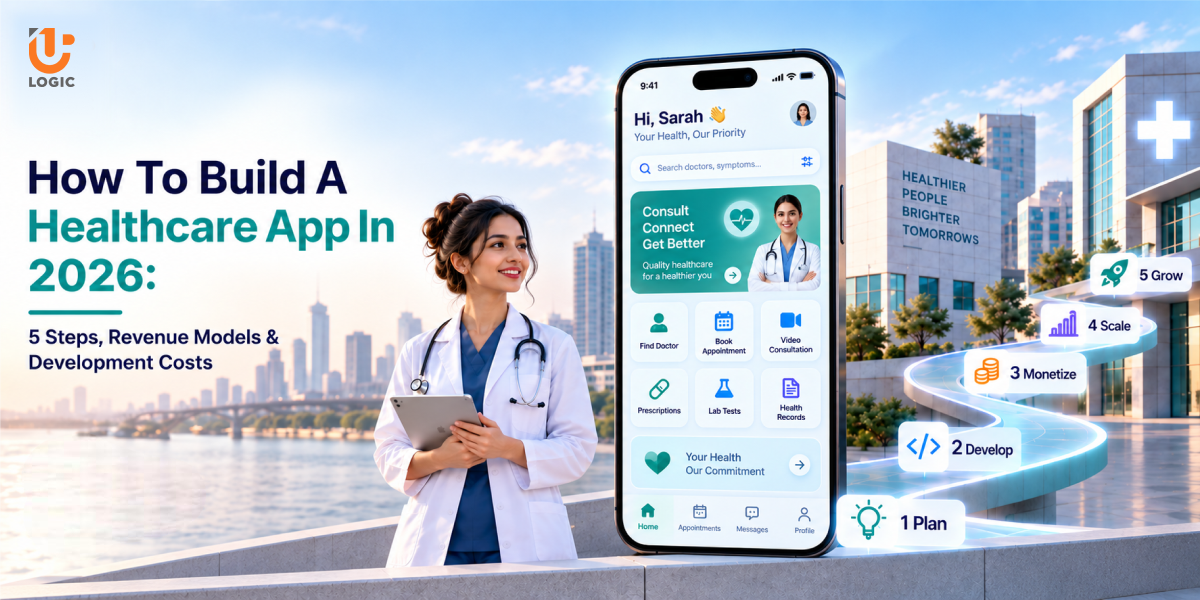
How to Develop a Healthcare App in 2026: 5 Steps
In the contemporary world, healthcare challenges are increasingly viewed as opportunities for AI adoption in clinical settings, owing to its potential to transform patient care and drive growth. Before stepping into custom healthcare app development, hospitals and startups should be familiar with legal and regulatory compliance. If launching an app in the US, HIPAA compliance is mandatory wherein the app should ensure secure storage, encryption, and audit logs.
With a complete breakdown of the app development, we help you get started with the overall process. If done correctly, you can deploy the healthcare app and offer continuous patient care.
1. Brainstorming, Planning, & Compliance
Ever analyzed the success of a healthcare app? It gets you to the clarity of the startup or hospital or clinic with the purpose of the app, the problems that they designed the app to follow, and the components that they need to tailor to the target audience. Similarly, the decision is into your hands whether it’s simply patient-centric for appointments scheduling, virtual visits, and medicine ordering or its an app that specifies a niche like Electronic Health Record (EHR) access. While healthcare platforms are not new, you need to do research on existing ones, discover opportunities where you still have scope, and plan your app accordingly to gather necessary attention from your target groups.
In a regulated industry, you should include preferences for the app to comply with region-specific privacy and security standards. If an app is classified for medical devices in Europe, it needs to be certified from CE Marking. Convey your concerns with the provider before agreeing to the app development.
2. Strategize Features & Conclude Tech Stack
Core features of the healthcare apps are responsible for the care discovery, secure access of health records, and virtual consultations. Decide the type of healthcare app you want to develop and that will help you define the features for your app. In patient-facing apps, you should integrate features like user registration, health tracking, appointment scheduling, payment integration, e-prescriptions, and push notifications. For medication management apps, the list changes to include smart pill reminders, dosage instructions, and adherence reporting.
Modern healthcare apps usually are built using technologies such as React.js for web dashboards and patient portals, React Native for mobile apps, and Swift/ Kotlin for native mobile apps. Real-time features like chat require Node.js. Whatever you expect, ensure that these technologies can turn that into reality.
3. UI/UX Design And Healthcare App Development
Create intuitive UI/UX designs for your healthcare apps while making them in compliance with compliance like HIPAA or GDPR. When hiring a development team, convey about your target audience, be it patients, doctors, or any healthcare provider to design interfaces that fulfil their needs. Next to that, develop the features, integrate interoperability standards, and add wearable integrations to draw health metrics. Execute the complete healthcare app development based on the approach you have chosen.
Develop healthcare apps in such a way to deliver role-based access controls, multi-factor authentication, and end-to-end encryption. A trusted partner like Uplogic takes control of the healthcare app development like a pro and assists you in different stages.
4. Testing The App for Every Crucial Element
While the app is developed with precision, you should never skip the testing stage. Assign the task to the quality assurance team of the healthcare app provider to test the app across various devices and confirm a smoother user experience and high performance in real-time functionalities. Since the app handles sensitive health records, checking the app for necessary compliance requirements is vital for hospitals. Every data store, access controls, and other aspects should be put into tests to ensure smooth performance.
Users should not face any bugs or glitches when using the healthcare app at times of more simultaneous users. Best practices for rigorous testing include using anonymized data, simulating critical scenarios, and maintaining traceability.
5. Launch The Healthcare App & Monitor Performance
The healthcare system is trained to move into the live environment after successful testing. Following the necessary guidelines, the team will launch your healthcare app across Android and iOS platforms. Once the app goes live, check how the users respond to the app and closely monitor it to identify any potential changes. Next, you can market the app to expand its visibility across your organization or target audience.
Turning Healthcare Apps Into Revenue-Generating Platforms
Beyond care delivery, hospitals can build a strong foundating using which they can generate revenue steadily. The healthcare ecosystem continues to be a profitable venture because of the expanding market opportunities. With the strategic approach, healthcare startups can tap into the million-dollar market and use technologies like advanced AI, IoT platforms, cybersecurity and cloud computing to convert the app into active diagnostic partners. The ways through which you can make revenue include:
- Subscriptions: Offer patients or healthcare professionals access to premium features through recurring subscription plans.
- Charges per consultation: Generate revenue by applying a service fee to virtual consultations, appointments, or specialized healthcare services.
- Enterprise licensing: License the platform to hospitals, clinics, diagnostic centers, or other healthcare organizations that require a tailored digital solution.
- Strategic partnerships: Collaborate with pharmacies, laboratories, insurers, medical device providers, or wellness companies to create mutually beneficial revenue streams.
Healthcare App Development Costs: A Complete Breakdown
The cost of developing a healthcare app depends on several interconnected factors rather than basic features alone. App complexity plays a major role, as telemedicine, EHR integration, AI diagnostics, IoT, and real-time monitoring require greater development effort. UI/UX design must prioritize accessibility and intuitive navigation for patients, clinicians, and administrators.
The technology stack, including frameworks, databases, APIs, and cloud services, also influences development requirements. Security and regulatory compliance demand encryption, authentication, consent management, and audit mechanisms to protect sensitive health data. Third-party integrations with laboratories, pharmacies, payment gateways, EHRs, and wearable devices can further expand the scope.
Additionally, backend infrastructure, testing, maintenance, scalability, and continuous updates contribute to long-term investment. Defining features, integrations, compliance needs, and scalability requirements early helps businesses plan resources and build a sustainable healthcare solution.
Types of Healthcare Apps You Can Niche Down for Your Services
Healthcare is a broad domain, which gives startups considerable scope to specialize. Instead of creating a generalized application, businesses can focus on a specific clinical or operational need and build a more purposeful product around it.
Potential niches include:
- Telemedicine apps for virtual consultations and remote patient care.
- Medication management apps for reminders, adherence tracking, and prescription-related support.
- Remote patient monitoring apps that connect patients with clinicians through connected devices and wearables.
- Mental wellness platforms offering digital resources, consultations, and personalized support.
- Chronic disease management apps designed to support patients living with conditions that require continuous monitoring.
- AI-powered diagnostic support platforms that assist healthcare professionals with data analysis and clinical decision support.
- Fitness and preventive healthcare apps that encourage healthier routines through activity, nutrition, and wellness tracking.
- Pharmacy and prescription platforms that simplify medication discovery, ordering, and fulfillment.
Uplogic Guards You In Healthcare Services Through Its Connected Systems
Building a healthcare application requires more than conventional software development expertise. It demands an understanding of healthcare workflows, data sensitivity, interoperability, security, and the evolving expectations of patients and providers.
Uplogic approaches healthcare app development by combining connected technologies with purpose-built digital solutions. From patient-facing applications and telemedicine platforms to AI-enabled systems and connected healthcare solutions, the focus remains on creating scalable products that can adapt to changing business and clinical requirements.
By bringing together technologies such as AI, IoT, cloud computing, and secure data infrastructure, healthcare businesses can develop applications that extend beyond basic service delivery and become integral components of their digital ecosystem.
What’s Your Takeaway
Healthcare apps are evolving from convenient digital interfaces into sophisticated platforms that can support clinical workflows, improve patient engagement, and create sustainable business opportunities. However, successful development depends on more than simply adding advanced technologies.
A clear niche, appropriate revenue model, scalable architecture, robust security, regulatory awareness, and carefully selected integrations all contribute to the viability of a healthcare application. Businesses that establish these foundations early can build solutions that are not only technologically capable but also commercially sustainable.
FAQ
Yes. AI-powered features often require additional data infrastructure, specialized development expertise, model integration, testing, monitoring, and security considerations. The overall impact depends on the type and sophistication of the AI functionality.
Common approaches include subscriptions, consultation fees, enterprise licensing, strategic partnerships, premium features, and transaction-based models. The appropriate model depends on the target users and the services offered.
The choice should be based on the specific healthcare problem being addressed, target audience, market demand, available expertise, regulatory considerations, and long-term business objectives.